
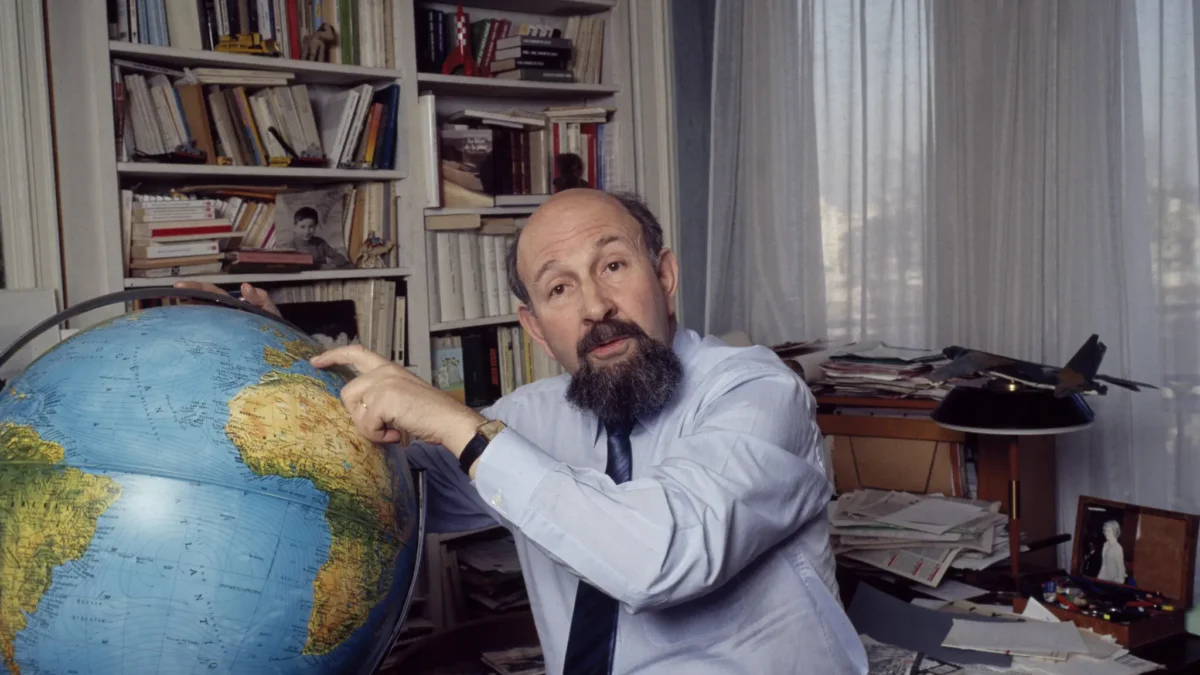
Yves Lacoste, the French geographer who exposed the United States’ deliberate bombing of North Vietnam’s river dikes during the Vietnam War and later revived the academic discipline of geopolitics in France, died on 20 June 2026 at his home in Bourg-la-Reine, in the Hauts-de-Seine department south of Paris. He was 96.
Lacoste was born on 7 September 1929 in Fez, in what was then the French Protectorate of Morocco. His father was a geologist, his mother a librarian. The family returned to France and he completed his secondary education at the Lycée Lakanal in Sceaux before going to the Sorbonne, where he pursued geography with the rigour that the French academic system demanded. He passed the agrégation in geography in 1952, the most competitive examination in French higher education, and began his teaching career at the Lycée Bugeaud in Algiers.
His most consequential act as a scholar came in 1972, during the American bombing campaign in North Vietnam. Using satellite imagery and precise geographic analysis, Lacoste demonstrated that the United States had deliberately targeted the dike system of the Red River Delta, a network of earthen barriers whose destruction could have flooded vast areas of densely populated farmland and killed enormous numbers of civilians. He published his findings in Le Monde diplomatique. The investigation caused an international scandal, forced a public denial from American officials, and stood for decades as one of the most striking examples of geographic methodology applied to holding military power accountable.
In 1976, he founded the journal Hérodote: Stratégies, Géographies, Idéologies, which became the principal French forum for critical and political geography and remains in publication today. The same year he published La Géographie, ça sert, d’abord, à faire la guerre, a title that translates roughly as “Geography is used, first of all, to make war.” The book argued that geography had never been a neutral academic discipline but a form of strategic and political knowledge long monopolised by states and military institutions, and that scholars had obscured this by reducing it to the memorisation of capitals and rivers. The argument shook the French academy and attracted both fierce hostility and a new generation of students.
His next target was the word “geopolitics” itself. After the Second World War, the term had been effectively banned in French academic discourse because of its association with Nazi Geopolitik. Through the 1980s, Lacoste and the Hérodote circle reintroduced it over sustained resistance, eventually establishing geopolitics as a legitimate and widely practised field within French universities.
He taught at the University of Paris VIII (Vincennes-Saint-Denis) and eventually became Emeritus Professor there. The International Geographical Union published a formal tribute following his death, and the journal he founded, now edited by others, carried a memorial from the editorial board. At 96, Lacoste had lived long enough to see the field he rescued from disrepute become one of the most widely taught in French political science. The Vietnam investigation that opened his public career is still cited in media studies and war crimes scholarship fifty years after it was published.