
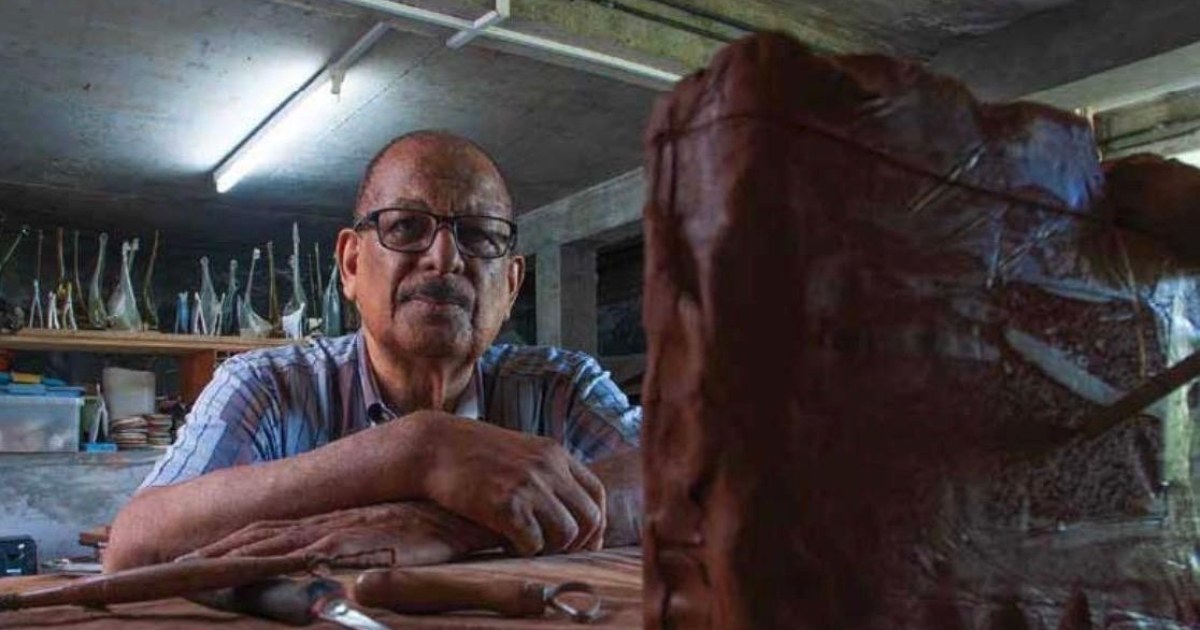
Victor Anicet, the Martinican painter and ceramist regarded as one of the leading artists of the French Caribbean, died on the morning of Monday, October 26, 2026, in Schœlcher, Martinique. He was 88.
“It is a monument that is leaving us,” said the artist Ernest Breleur, who co-founded the Fwomajé group with him, speaking to RCI. “He brought something not only to Martinique, but to the world.”
Roots in Le Marigot
Anicet was born in Le Marigot on April 18, 1938, the fifth of nine children of a farming mother and a fisherman father, who died when Victor was seven. As a boy he met the priest and archaeologist Robert Pinchon and helped on digs near his home. Cleaning fragments of Arawak pottery there sparked an interest in the island’s Amerindian peoples that ran through his whole career.
He studied at the school of applied arts in Fort-de-France, then left for Paris at 17 to train in ceramics, graduating first in his class in 1961. He went on to study with potters in France, with Bernard Leach’s circle in St Ives in England, and in Germany.
Fwomajé and public works
Back in Martinique from 1967, he taught art in schools in Martinique and Guadeloupe. In 1984 he co-founded Fwomajé, a collective named after the Creole word for the kapok tree that set out to define a Caribbean aesthetic. He created stained glass for the co-cathedral in Saint-Pierre, dedicated in 2006, and his works stand in public spaces in Fort-de-France, Pointe-à-Pitre, Le Marin, Le Diamant and other towns.
He exhibited in France, the Caribbean, the United States, Germany and South Korea. His work was shown at the São Paulo Biennial and, in 2025, at the Centre Pompidou in Paris. In 2024 the Fondation Clément held the retrospective Opacité & transparence, covering his work from 1967 to 2024. He was made a knight of the Légion d’honneur.
Tributes
In 2017 the Saint-James lycée in Saint-Pierre was renamed Lycée Victor Anicet in his lifetime. Bernard Hayot, president of the Fondation Clément, described him as “an artist of rare sensitivity, a free and demanding creator, whose singular work profoundly marked art in the Caribbean.”