
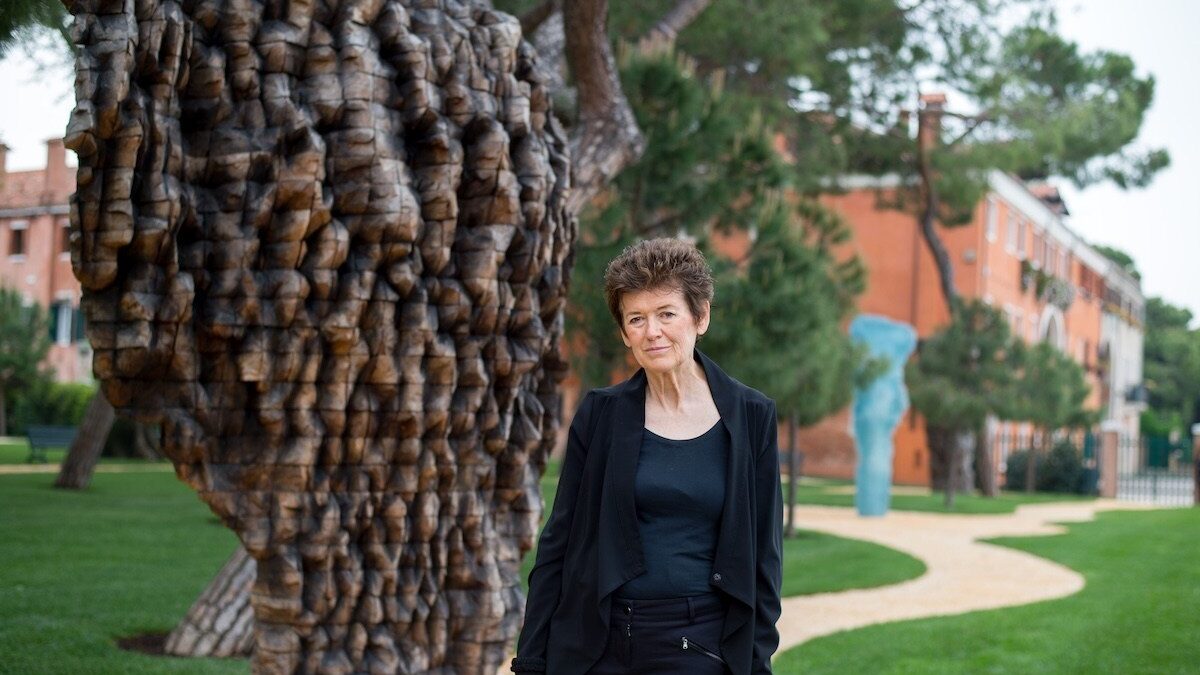
Ursula von Rydingsvard, the sculptor whose towering works of cut and stacked cedar brought a human warmth to the cool language of Minimalism, died in New York on Tuesday, October 27, 2026, after a battle with Alzheimer’s disease. She was 84.
“Despite enormous obstacles, Ursula had an inimitable drive to create and to wrest nearly unimaginable images into a monumental scale,” said Mary Sabbatino, vice president and partner of her gallery, Galerie Lelong. “Her sculptures stand as sentinels to inspire new generations, especially women sculptors, to dream new possibilities.”
From refugee camps to Columbia
She was born in Deensen, Germany, on July 26, 1942, to a Polish mother and a Ukrainian father, who had been forced into a Nazi labour camp. The family spent the years after the war in displaced persons camps before emigrating in 1950 to Plainville, Connecticut, where her mother worked in a restaurant and her father in a factory. In Plainville, she later said, there was “no such thing as an artist.”
She earned a bachelor’s degree at the University of New Hampshire and a master’s at the University of Miami. After her first marriage, to Milton von Rydingsvard, ended in 1973, she moved to New York with their daughter, lived on food stamps in Harlem and enrolled in Columbia University’s art program, studying with Meyer Schapiro and George Sugarman. She graduated in 1975.
Cedar
She began working with cedar in the mid-1970s, rejecting what she called Minimalism’s lack of humanity: “There was no sexiness, and there wasn’t even any humanity.” She insisted on milled 4×4 cedar beams rather than tree trunks, which she said “don’t ask anything of you. They’re like a blank piece of paper,” and cut, stacked and glued them into undulating forms that seemed almost alive. She later also worked in bronze, silk, hair and cow intestines.
Her best-known works include Zakopane (1987), named after the Polish town where her mother was born, and Ona (2013), a 19-foot, 12,000-pound sculpture beneath the oculus of the Barclays Center in Brooklyn. “I would actually love people to touch it,” she said when it was unveiled. Her work was shown at Storm King Art Center, Yorkshire Sculpture Park and, in 2018, at the Fabric Workshop and Museum in Philadelphia.
Personal life
She moved her studio to Brooklyn in 1981 and worked there for the rest of her career. In 1985 she married the neuroscientist and Nobel laureate Paul Greengard, who died in 2019. She is survived by her daughter, Ursula Anne von Rydingsvard.