
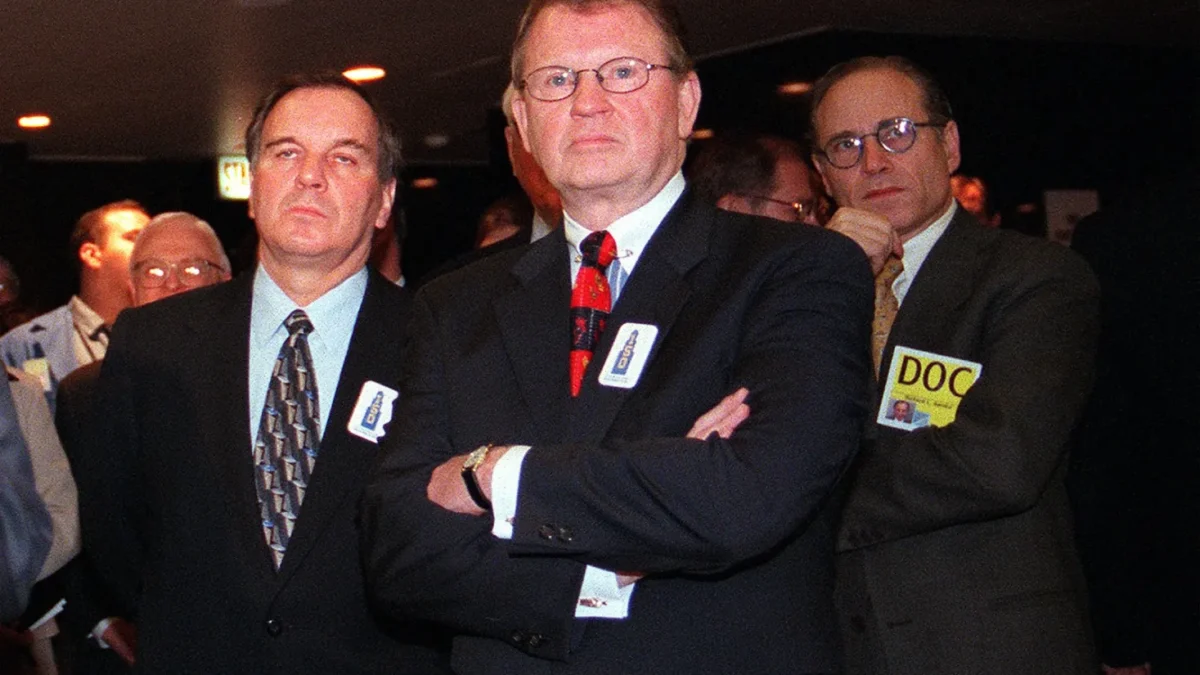
Thomas R. Donovan, who served as the patronage chief of Mayor Richard J. Daley’s Chicago political machine before guiding the Chicago Board of Trade through the most disruptive transformation in its history, died on 14 June 2026 at his home in Palos Park, Illinois. He was 88.
Donovan was born on 13 September 1937 in the Bridgeport neighbourhood of Chicago, the South Side enclave that produced Daley himself and formed the geographic and cultural core of the city’s Democratic organisation. He was educated at De La Salle Institute, the Catholic high school in Bronzeville, and later took evening classes at the University of Illinois Navy Pier campus while pursuing glaziers union membership, the kind of dual-track education that characterised ambitious young men working their way through Chicago’s institutional landscape in the late 1950s.
His rise in city politics was swift. Under Mayor Daley he became patronage chief, the official responsible for distributing city jobs across the thousands of positions that kept the machine functioning. The role placed him at the centre of the system that made Chicago’s Democratic organisation the most studied and written-about political machine in twentieth-century American politics. When Daley died in December 1976, Donovan helped engineer the succession of 11th Ward Alderman Michael Bilandic as mayor, and then served as Bilandic’s Chief of Staff.
The transition from city hall to LaSalle Street came in 1979, when Donovan joined the Chicago Board of Trade as secretary. He became President and Chief Executive in 1982 and held the position for nearly twenty years, the longest tenure in modern CBOT history. The institution he inherited was built on open-outcry trading: hundreds of traders in coloured jackets shouting and signalling in the trading pits, a system unchanged in its essentials since the nineteenth century. The institution he shaped over two decades was something different.
His signature achievement was Project A, the CBOT’s electronic trading platform. Introducing it required overcoming fierce resistance from floor traders whose livelihoods depended on the open-outcry system, and from members who saw the pits as the soul of the exchange. Donovan pushed it through regardless, understanding that an institution that refused to adapt to computing would be replaced by one that did not. That decision placed the CBOT on the path that eventually led to its 2007 merger with the Chicago Mercantile Exchange to form CME Group, the world’s largest derivatives exchange.
After leaving the CBOT in 1998, he became founding chairman of Quantum Crossings LLC, a Chicago-based technology, security, and electrical services firm. He was inducted into the Futures Industry Association Hall of Fame, the exchange industry’s formal recognition of a career that had reshaped commodity futures trading.
He is survived by extended family including siblings and nieces and nephews. No funeral details beyond services at St. Alexander Catholic Church in Palos Heights were made public by the family.