
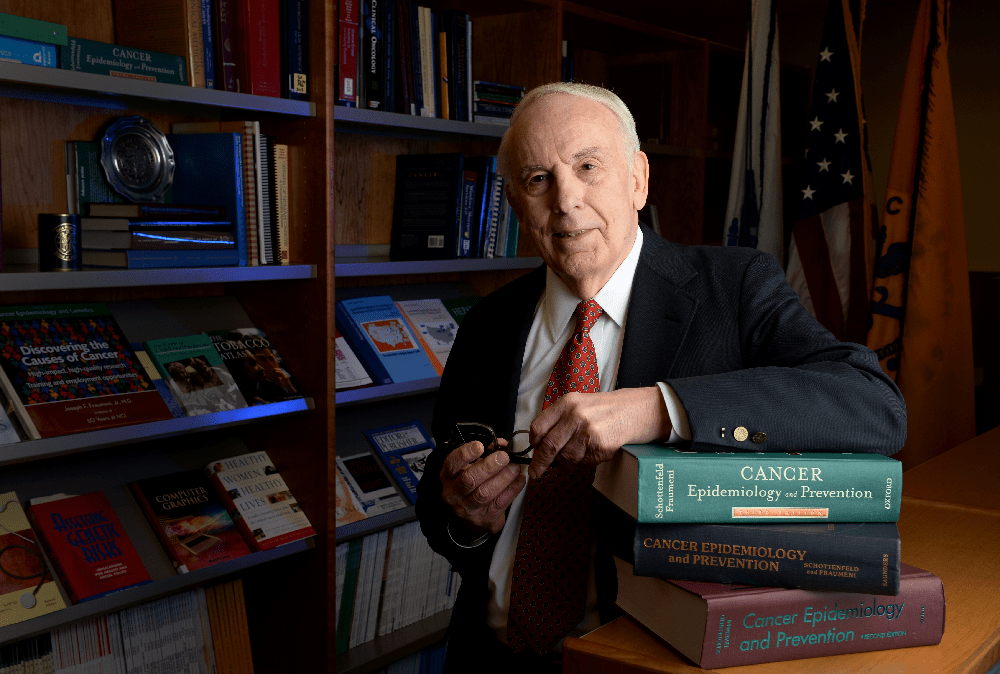
The world of cancer research mourns the loss of Joseph F. Fraumeni, Jr., MD, a luminary in the field who was the founding director of the NCI’s Division of Cancer Epidemiology and Genetics within the National Institutes of Health’s Intramural Research Program.
Dr. Fraumeni passed away on June 22 at the age of 93, leaving an indelible mark on cancer epidemiology.
Over a span of fifty years from the 1960s, Dr. Fraumeni led the world’s preeminent cancer epidemiology research program, significantly advancing our understanding of cancer causes and mentoring numerous successful scientists who now lead epidemiology programs worldwide.
To those who collaborated with him, Dr. Fraumeni was known as a generous and inquisitive investigator with an exceptional ability to discern patterns and connections in cancer epidemiology. His family affectionately referred to him as “Skippy.”
As one of the world’s foremost cancer epidemiologists, Dr. Fraumeni’s achievements are both extensive and impactful. Always driven by what he termed “the interesting questions of the time,” he approached research with a broad vision and a step-by-step approach to scientific discovery.
His questions often led to the creation of new approaches in cancer epidemiology. He developed national cancer maps that became a global standard, sparking research into high-risk areas. He recognized the importance of collecting and analyzing biospecimens from well-designed studies, anticipating the advancements in technology that would enhance their utility. He championed collaboration both within the NCI and internationally. He also integrated new molecular technologies into population-based and family studies.
As the founder of molecular epidemiology, he laid the groundwork for researchers to dissect the contributions of various exposures in relation to genetic and environmental factors in cancer development and progression.
When tackling complex problems in cancer epidemiology, one inevitably encounters works that bear Dr. Fraumeni’s influence, whether as an author or through his mentorship of “trainees.” Truth be told, we were all “trainees,” regardless of our positions.