
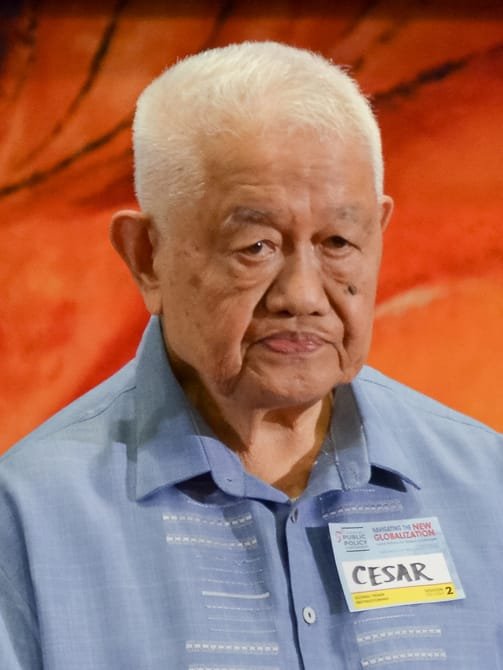
Cesar Virata, the former Philippine prime minister who shaped the country’s economic policies during the Marcos era, died on October 2, 2026, in Kawit. He was 95.
Virata’s death was confirmed by family sources. He passed away at his home in Kawit, the town where he was born. His passing closes a chapter on one of the most influential figures in Philippine politics and economics during the 1980s.
He served as the country’s fourth and penultimate prime minister from 1981 until Ferdinand Marcos was ousted in 1986. During that period, he was also secretary of finance from 1970 to 1986, making him a central figure in Marcos’s administration. His tenure in the finance department spanned 16 years, overlapping with his time as prime minister.
Virata’s role in shaping economic policy earned him recognition in the Philippines. His influence was felt across the country’s financial sector, with many crediting him for steering the economy through turbulent political waters.
Before he stepped away from government, he was also the corporate vice chairman of Rizal Commercial Banking Corporation. His career included a stint at the University of the Philippines Diliman, where the Cesar E. A. Virata School of Business bears his name.
Born Cesar Enrique Aguinaldo Virata, he studied at the Wharton School of the University of Pennsylvania. His education in the United States helped shape his approach to finance and management. Despite his government service, he remained active in the private sector.
In recent years, he was known more for his role in the banking industry. His name appeared frequently in financial circles, and he was seen as a stabilizing presence at Rizal Commercial Banking Corporation.
His death comes at a time when Philippine politics remains sensitive to the legacies of the Marcos era. Virata’s name has appeared in discussions about economic policy during that period.
His family has yet to release a statement. But sources close to the family said he had been in good health until recent months.
Virata’s influence extended beyond politics. He was associated with the Cesar E. A. Virata School of Business at the University of the Philippines Diliman, which trains future leaders in business and management.
His passing leaves a gap in Philippine political history. The country’s fourth prime minister was known for a pragmatic approach during a tumultuous time.
He was born in Kawit, the town famous for the declaration of Philippine independence in 1898. His roots in Kawit connected him to the country’s nationalist history, even as he worked to modernize its economy.
His death also reminds the public of the political and economic landscape of the 1980s. The Marcos regime faced mounting opposition, and Virata’s role in the government became a focal point for discussions about those years.
As a public figure, he was known for his low profile and technical expertise. His time in office was marked by efforts to stabilize the Philippine economy, which had been strained by political unrest.
Virata’s legacy includes not only his political career but also his contributions to business education and banking. The firm hand he displayed in managing the country’s finances remains a point of reference for economists and policymakers.
He is survived by family members, though details remain private. His death has been reported by multiple news outlets in the Philippines, noting his influence on the country’s economic history.
Observers note that his death closes a chapter on a period of Philippine history marked by political upheaval and economic effort. His name remains linked to a time when financial stability was often challenged but ultimately maintained through steady leadership.
According to Dead-People.