
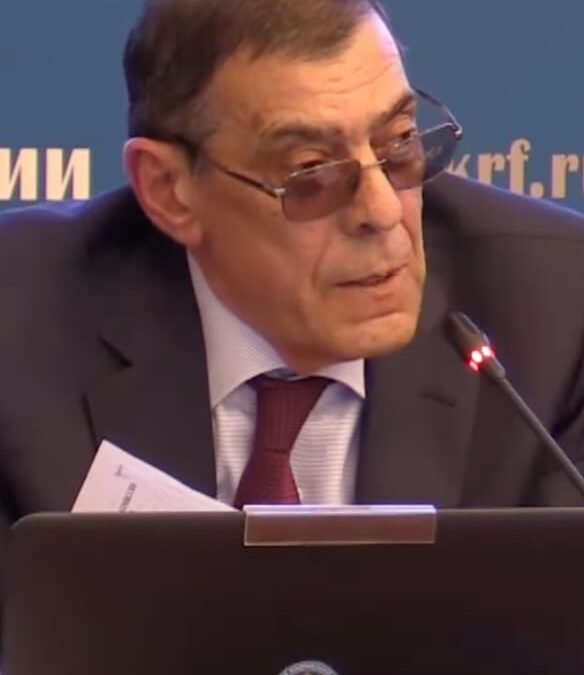
Boris Ebzeyev was a Russian jurist and legal scholar who served as a judge on the Constitutional Court of the Russian Federation from 1991 to 2010, contributing to the development of Russian constitutional law and jurisprudence across the most formative years of the post-Soviet Russian state, when the country’s new constitutional framework was being interpreted and applied for the first time by judges who were effectively creating the doctrines and precedents that would define Russian constitutional law for subsequent decades. He died in 2026 at an advanced age.
He was born in the Soviet Union and pursued a career in legal scholarship and academic law before the political transformations of the late 1980s and early 1990s created the conditions under which a genuinely independent constitutional court could be established. The Constitutional Court of the Russian Federation was created in 1991 as part of the transformation of Soviet legal institutions that accompanied the dissolution of the Soviet Union, and it was given a mandate to review the constitutionality of legislation and executive acts that was without precedent in Russian legal history. The Tsarist and Soviet legal systems had not included an independent constitutional review mechanism, and the creation of the Constitutional Court represented a genuine institutional innovation whose significance for the development of Russian democracy and rule of law depended on the quality and independence of the judges who served on it.
He was among the first judges appointed to the Constitutional Court in 1991, joining an institution that was finding its footing in an extraordinarily turbulent period of Russian political history. The early years of the Russian Federation saw constitutional crises, including the confrontation between President Yeltsin and the Russian parliament that culminated in the shelling of the parliament building in October 1993, and the adoption of the new Russian Constitution in December 1993 that restructured the constitutional framework the court operated within. Serving as a constitutional judge through those events required both the legal expertise to apply constitutional principles rigorously and the institutional courage to maintain the court’s independence in circumstances where political pressures on judicial institutions were intense and the consequences of independent judicial decisions could be severe.
His scholarly work in constitutional law ran parallel to his judicial service and contributed to the academic foundations of Russian constitutional jurisprudence. The development of constitutional law in a new state requires both judicial practice and legal scholarship to develop together, with theoretical frameworks informing the interpretation of specific constitutional provisions and the practical experience of constitutional adjudication feeding back into the theoretical development of the discipline. His dual contribution as practitioner and scholar gave him a distinctive place in the development of Russian constitutional law across the two decades of his judicial service.
He served on the Constitutional Court until 2010 and continued his academic work after his judicial service ended, remaining a respected voice in Russian legal scholarship. His contribution to the establishment of constitutional review as an institution in Russian legal life, during the years when that institution was most in need of judges of genuine quality and integrity, was his most significant legacy. He died in 2026.