
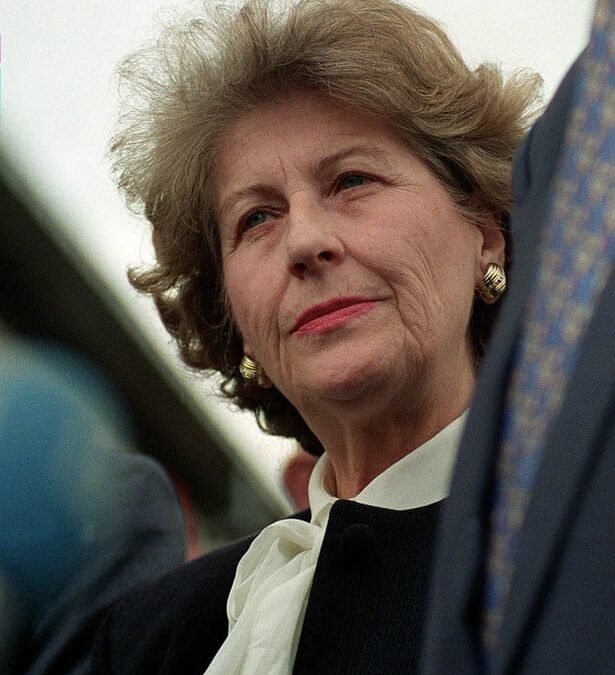
Biljana Plavšić, the former leader of Republika Srpska, died on October 1, 2026, in Belgrade at the age of 96. Her death closes a chapter on a figure whose life spanned scientific achievement and political conviction.
Born in Tuzla in 1930, Plavšić built a career as a university teacher and scientist before entering politics. She taught biology at the University of Sarajevo and later served as dean at its Faculty of Natural Sciences and Mathematics. Her academic work included research in the United States and across Europe, supported by her status as a Fulbright Scholar.
Her transition to politics was marked by her leadership of Republika Srpska from 1996 to 1998. Plavšić became a prominent figure during the aftermath of the Bosnian War, a conflict that lasted from 1992 to 1995 and resulted in the deaths of an estimated 100,000 people. Her tenure as president followed the Dayton Accords, which aimed to bring peace to Bosnia and Herzegovina.
In 2001, Plavšić was convicted by the International Criminal Tribunal for the former Yugoslavia of crimes against humanity. The tribunal found her responsible for participating in actions connected to the war, a conviction that added a dark layer to her political legacy. She was sentenced to serve time but was released in 2009 after serving part of her sentence.
Throughout her life, Plavšić maintained her scientific pursuits alongside her political career. She was known for her academic publications and her role as a researcher. Her work in biology and natural sciences was recognized in academic circles long before her political involvement.
Her death was confirmed by local sources in Belgrade. No details about her health or the cause of death have been made public, but reports indicated she had been suffering from cancer. She spent her last years in Serbia, away from the political upheavals that marked her earlier career.
Plavšić’s legacy is complicated. She was a scientist with a notable academic record, but her role during a period of violence in Bosnia has cast a long shadow. Critics pointed to her leadership during the Bosnian War as a source of her conviction. Others remember her as a figure who also contributed to scientific research and education.
Her passing was quietly noted in Belgrade, where she had lived since her release from prison. The international community has not issued formal statements, but her death prompts reflection on a life that embodied both scientific pursuit and political controversy.
In her later years, Plavšić rarely spoke publicly about her wartime involvement. Her death leaves behind a figure often remembered for her scientific achievements and her political infamy. Her life story remains intertwined with one of the most turbulent periods in the Balkans.
According to Dead-People.