
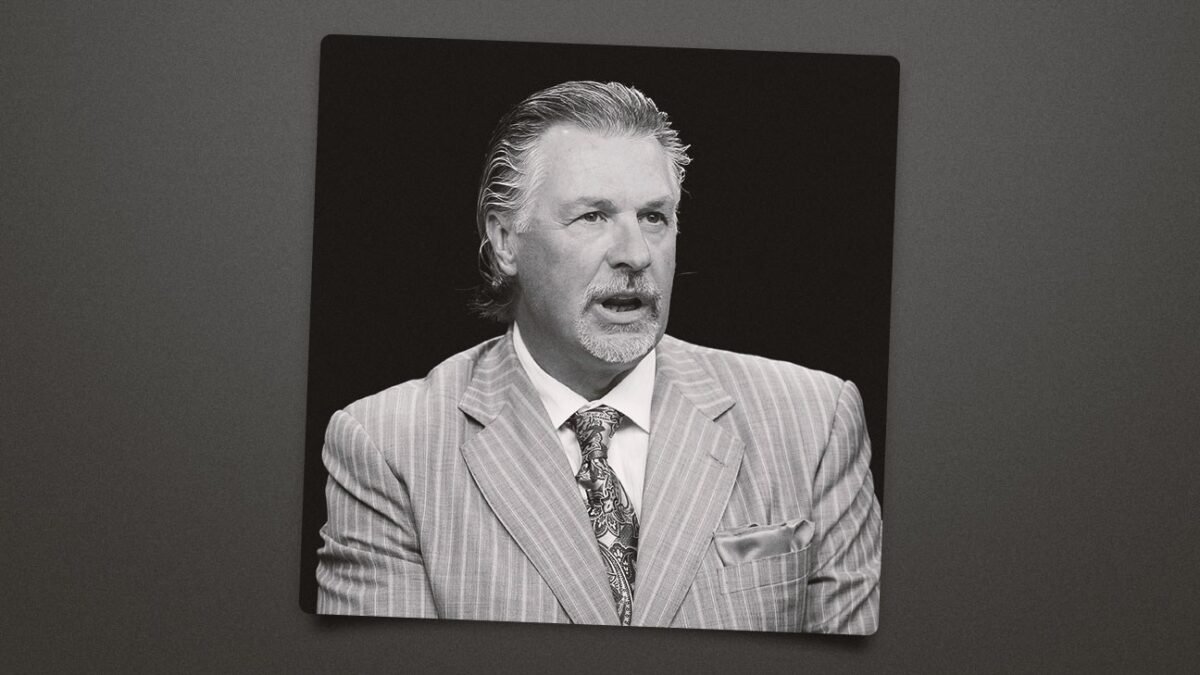
Barry Melrose was fired by the Los Angeles Kings in April 1995 with seven games left in the regular season. Thirty minutes later, ESPN signed him to work as a studio analyst for the upcoming NHL playoffs.
That pivot defined the last three decades of his career. Melrose, who died Wednesday at 70, spent nearly 30 years as the network's hockey voice, a mulleted, cigar-smoking presence who made the sport accessible to a broad American audience. The cause of death wasn't immediately available. In October 2023, he revealed he had been diagnosed with Parkinson's disease and was retiring.
"I've had over 50 extraordinary years playing, coaching and analyzing the world's greatest game, hockey," he said in a statement at the time. "It's now time to hang up my skates and focus on my health, my family, including my supportive wife, Cindy, and whatever comes next."
NHL Commissioner Gary Bettman confirmed Melrose's death in a statement. "From the flowing locks of his distinctive mullet to the flared lapels of his trademark long suit coats, Barry Melrose cut an unmistakable figure whenever you were fortunate enough to run into him at a rink or catch him on your television screen," Bettman said. "You were even more fortunate if you engaged him in conversation or listened to his analysis, because he never failed to boost your love of the game of hockey."
Before the suits and the studio lights, Melrose was a blue-collar defenseman. Born July 15, 1956, in Kelvington, Saskatchewan, a town of 900 people 400 miles northwest of Winnipeg, he was raised on a nearby farm. His father, James, built a rink on their property, and Melrose started skating when he could walk. At 5, he took his first stick to the face and got a black eye. Later, he sold four pigs to buy his first pair of Tackaberry ice skates. His favorite NHL player was Tim Horton, a defenseman.
He played three seasons of junior hockey with the Weyburn Red Wings and Kamloops Chiefs from 1973 to 1976, then joined the Cincinnati Stingers of the World Hockey Association after being selected 37th in the WHA Draft. The Montreal Canadiens had taken him 36th in that year's NHL Draft. After 178 games over three seasons with the Stingers, he appeared in 300 NHL games with the Winnipeg Jets, Toronto Maple Leafs and Detroit Red Wings through the 1985-86 season, collecting 10 goals and 23 assists with 728 penalty minutes. At 6 feet and 205 pounds, he was not afraid to mix it up.
He finished his playing career with the American Hockey League's Adirondack Red Wings in 1986-87 and guided the Medicine Hat Tigers to the Western Hockey League championship in 1988, his first season as a coach. He led the Seattle Thunderbirds for one season and Adirondack for three more, with the Red Wings winning the Calder Cup in 1992, when he also served as their general manager.
That summer, the Kings, owned by the free-spending Bruce McNall, won a bidding war with the Detroit Red Wings, signing Melrose to a four-year contract in June 1992 worth a reported $1.3 million, believed to be the most ever paid to a first-time NHL coach. In his first season, he took Wayne Gretzky's Kings to the precipice of their first Stanley Cup. Los Angeles edged the Maple Leafs on the road in Game 7 of the 1993 conference finals to advance.
"His idea of how the game should be played focused on speed," Gretzky wrote in the foreword to Melrose's 2012 book, Dropping the Gloves: Inside the Fiercely Combative World of Professional Hockey. "He and I had a meeting of the minds on day one. From then on, it was a pleasure playing for him. Sometimes it was an adventure, because Barry was always willing to try things."
Said Luc Robitaille in the 2012 book A Season in Time: "If Barry had his way, you would never take a backward step."
The Kings lost the Stanley Cup Final to the Canadiens in five games, three of them in overtime, and missed the playoffs the next season. Melrose was fired in April 1995, three months after Gretzky was traded to the St. Louis Blues, with seven games left in the regular season.
ESPN picked him up that same day. He called games part-time the next season before joining full-time for the 1996-97 campaign. "When [people] watch me on TV, I want them to go, 'Geez, I'd like to go for a beer with Barry Melrose and talk hockey. He seems like he'd be very interesting,'" he told the Los Angeles Times in 1995.
He left ESPN in June 200
According to Hollywood Reporter.