
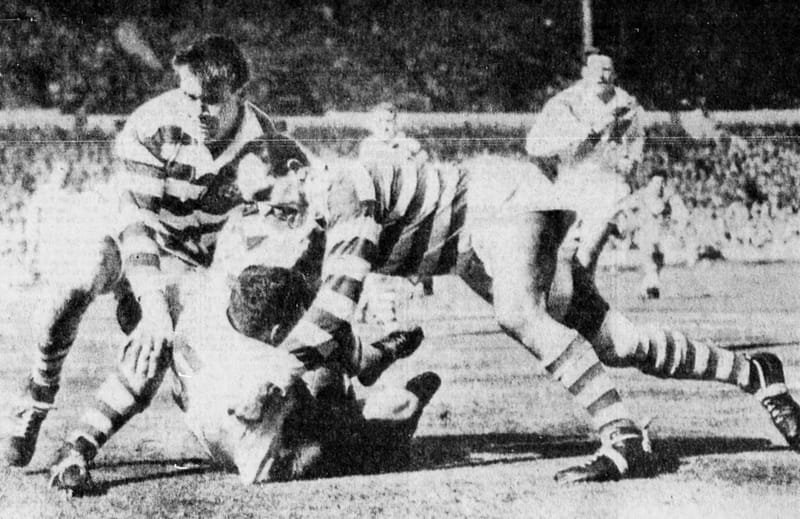
Billy Boston was a Welsh professional rugby league footballer who is regarded as one of the greatest players in the history of the game, who scored 478 tries in 487 appearances for Wigan Warriors from 1953 to 1968 to become the club’s all-time leading try scorer, and who was one of the most celebrated Black athletes in British sporting history, his achievements at Wigan coming at a time when Black British athletes faced significant racial discrimination and when his success as a Black player at a major British professional sports club was itself a form of social statement. He died on 5 June 2026 at the age of 92.
He was born William John Boston on 6 August 1934 in Tiger Bay, Cardiff, the dockland neighbourhood of the Welsh capital that was home to one of the oldest Black communities in Britain, a community formed from the settlement of sailors and workers from across the British Empire who made Cardiff’s docks their home from the nineteenth century onward. Tiger Bay, subsequently known as Butetown, has produced an extraordinary concentration of notable figures in British entertainment, sport, and public life relative to its small size, and Boston grew up in a community whose mixture of cultures and its specific location at the intersection of Welsh working-class culture and Black British experience gave him a particular formation as a person and as an athlete.
His early rugby career was in rugby union, the amateur form of the game that dominated Welsh sporting culture and through which many of the finest Welsh players first developed their abilities before the Northern rugby league clubs recruited them with the promise of professional wages that the amateur code officially prohibited. His exceptional talent, demonstrated in Welsh Schools and junior rugby union and in a brief period with Cardiff RFC, attracted the attention of Wigan, who signed him for a reported £3,000 in 1953, a significant signing fee for the period that reflected their assessment of his extraordinary potential.
His record of 478 tries for Wigan across fifteen seasons placed him among the most prolific try scorers in the history of rugby league, a game in which scoring tries is the primary measure of an attacking player’s contribution, and his consistency in scoring across the full span of his career demonstrated that his try-scoring ability was not the product of a single exceptional period but of sustained excellence across more than a decade of professional competition. His pace, his power, and his ability to score from seemingly impossible positions gave him a quality that defenders who faced him in his prime consistently described as uniquely challenging to contain.
He played for Great Britain in international rugby league, touring Australia and New Zealand where he scored tries at a remarkable rate against the best defensive players that the Southern Hemisphere game produced. His touring record in Australia and New Zealand confirmed his status as a genuinely world-class player whose ability to perform at the highest level against the toughest opposition placed him in the company of the greatest players the game has produced across its history. His impact on Wigan’s rugby league culture was such that the club has acknowledged him as their greatest ever player.
He was inducted into the Rugby League Hall of Fame, received the MBE, and was honoured with a statue outside the Wigan Warriors’ stadium that stands as the community’s physical tribute to the greatest player in the club’s history. He was 92 years old.