
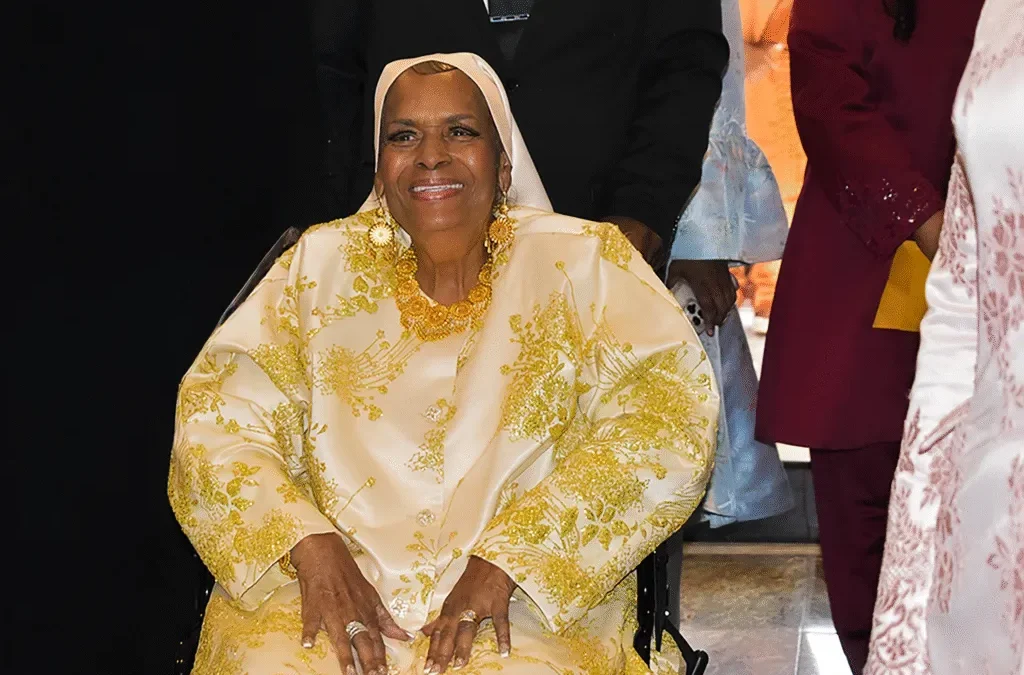
Khadijah Farrakhan was an American woman who was known primarily as the wife of Louis Farrakhan, the leader of the Nation of Islam, the African American religious and political organisation whose influence on African American political and cultural life since the 1930s has been one of the most significant and contested dimensions of Black America’s twentieth-century experience. She died on 4 August 2026 at the age of 73 in Chicago, Illinois, having been married to Farrakhan since 1953 and having been at his side across the most significant decades of his public life.
She was born Betsy Ross in 1952 or 1953 and married Louis Farrakhan, then known as Louis Walcott, in 1953 when they were both teenagers, a marriage that began before Farrakhan had joined the Nation of Islam and that became the central personal relationship of his life across the seven decades of their marriage. The Nation of Islam, founded by Wallace Fard Muhammad and subsequently led by Elijah Muhammad from the 1930s through 1975, was a religious organisation that combined Islamic theology with a specific racial theology emphasising Black self-determination, economic independence, and racial pride that distinguished it sharply from both mainstream American Islam and the integrationist mainstream of the Civil Rights Movement.
Farrakhan joined the Nation of Islam in 1955, two years after their marriage, and rose through its ranks under Elijah Muhammad to become the minister of the Harlem mosque and one of the most prominent figures in the organisation. When Malcolm X was assassinated in 1965, Farrakhan’s role in the organisation’s condemnation of Malcolm’s departure from the Nation before the assassination was a source of controversy that remained part of the public record of his life. After Elijah Muhammad’s death in 1975 and the transformation of the Nation of Islam under Warith Deen Mohammed toward mainstream Sunni Islam, Farrakhan reconstituted a separate Nation of Islam organisation in 1978 that maintained Elijah Muhammad’s original theology and programme, and led that organisation through its period of greatest national visibility, which included the Million Man March in Washington in 1995 that drew an estimated 800,000 to one million African American men to the National Mall.
Khadijah Farrakhan was present through all of those decades as the personal partner of a man whose public life encompassed both celebrated advocacy for Black self-determination and economic independence and deep controversy over his statements about Jewish people, white people, and other groups that generated sustained criticism across the decades of his leadership. Being the wife of a figure of Farrakhan’s public prominence and controversy meant sharing in the public dimensions of that life without the direct political or religious role that might have given her an independent public identity of her own, and the tributes that followed her death primarily described her through her relationship to her husband and through the qualities of personal character and family devotion that those who knew her personally attested to.
Louis Farrakhan paid tribute to his wife of seventy years following her death, describing the personal loss of the companion who had shared his entire adult life and the entire arc of the institution whose leadership had defined that life. She was 73 years old.